
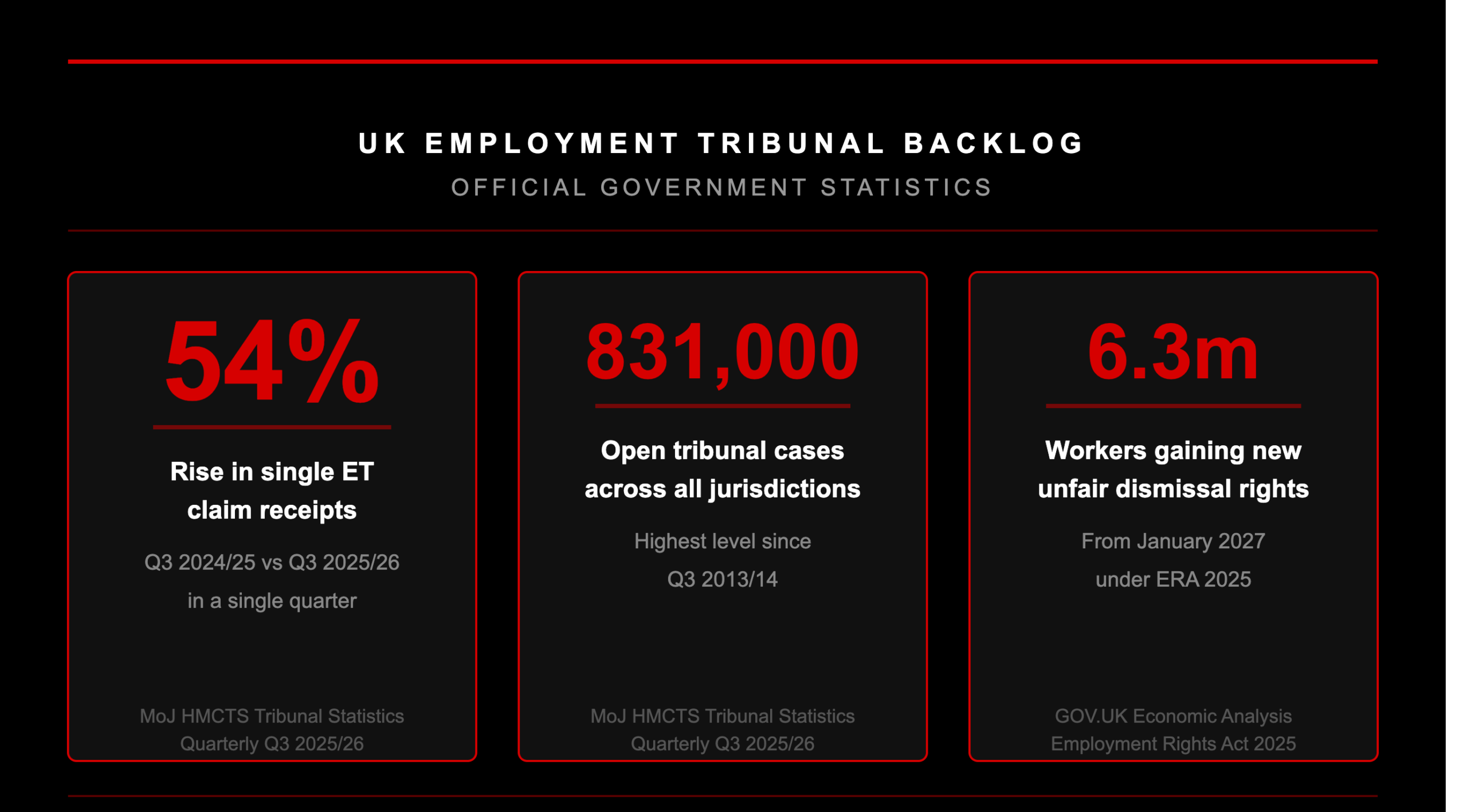
The employment tribunal backlog is not an abstract legal problem. It lands directly on employers facing live claims, costing them time, money, and leadership capacity month after month. According to the Ministry of Justice Tribunal Statistics, single employment tribunal receipts increased by 54% in October to December 2025 compared with the same period a year earlier. In the same quarter, cases that have been closed or concluded by the tribunal system fell by 34%. The gap between claims arriving and cases resolving is widening. Every employer with an open claim sits inside that gap.
What the official data actually shows
The Ministry of Justice publishes quarterly tribunal statistics through HMCTS. The Q3 2025/26 figures, published March 2026, are unambiguous. The overall tribunal open caseload reached 831,000 by December 2025, the highest level since Q3 2013/14. Single employment tribunal open caseload increased 49% year on year in that same quarter. The system is not coping and receipts have exceeded disposals consistently across the past year, and the structural imbalance shows no sign of correction. At that rate, clearing the existing backlog without any new claims would take nearly two years.
Read how rising AI adoption triggers workforce changes.
What this costs employers in practice
The employment tribunal backlog employers must navigate translates into three distinct pressure points.
Duration of exposure
An average claim for unfair dismissal or discrimination now takes approximately 12 months to be listed for hearing, according to Ministry of Justice data. Some cases in London and the Southeast are being listed into 2028 and 2029. Throughout that entire period, the claim remains live. Legal costs accumulate and management attention remains divided.
Evidence degradation
When a hearing takes place 12 to 18 months after the original event, witness recall weakens. A process that was followed correctly, a decision that was made fairly, a conversation that was documented properly: all of these become harder to evidence as time passes. The backlog does not reduce the employer’s burden of proof, it simply makes meeting that burden more difficult.
Leadership distraction
Senior leaders and line managers are required to gather documentation, provide statements, liaise with legal advisers, and attend hearings. That time cannot be recovered, and for smaller organisations, the impact on operational capacity is disproportionate.
Read how rising AI adoption triggers workforce changes.
The compensation landscape is about to change
The financial stakes are rising and the Employment Rights Act 2025 received Royal Assent on 18 December 2025. From 1 January 2027, the qualifying period for unfair dismissal protection will reduce from two years to six months (GOV.UK, business.gov.uk). The Government’s own economic analysis estimates that 6.3 million employees, approximately 22% of all employed workers aged 16 and over, currently sit in the six-months-to-two-years bracket and will gain protection immediately when that change comes into force (GOV.UK Economic Analysis, Employment Rights Act 2025).
The compensatory award cap for unfair dismissal will also be removed entirely from 1 January 2027. Currently, that cap sits at £118,223 or 52 weeks’ gross pay, whichever is lower. From January 2027, there is no ceiling. Discrimination claims already carry uncapped compensation. From that date, unfair dismissal will carry equivalent financial exposure. The employment tribunal backlog employers are already managing will grow considerably heavier.
From October 2026, the time limit for bringing most tribunal claims will also extend from three months to six months (ACAS, Employment Rights Act 2025). A wider window for claims, combined with a lower qualifying threshold and uncapped awards, points firmly in one direction.
Read about the governance challenge of agentic AI
Why the backlog will not clear itself
The structural cause is not complex. Tribunal fees were abolished in 2017 following the Supreme Court ruling in UNISON v Lord Chancellor. Claims increased, but judicial capacity did not. The Judicial Attitude Survey found that 59% of first-tier employment tribunal judges considered their workload too high. The Ministry of Justice Q3 2025/26 statistician’s note confirms that single employment tribunal disposals have declined even as receipts have reached their highest level since 2012/13.
The Employment Rights Act 2025 will extend the ACAS early conciliation period from six weeks to twelve weeks, effective December 2025. That provides one mechanism for resolution before claims reach the tribunal. It is not sufficient to counterbalance the projected volume increase from the qualifying period change alone.

Prevention is the only variable employers control
The employment tribunal backlog employers face cannot be resolved from outside the system. What can be controlled is the probability of entering it. Claims rarely materialise without warning, they follow poorly managed performance conversations, inconsistent application of policy, inadequate documentation, and leadership teams without the skills to handle difficult people situations. Each of those is a preventable failure.
ACAS guidance is clear on what constitutes a fair process. Employers whose internal procedures align with that guidance, and whose managers are equipped to follow them consistently, are substantially better positioned. That alignment is not a compliance exercise, it is a strategic investment in avoiding a system that now takes over a year to resolve even the simplest case.
Frequently asked questions
What does the employment tribunal backlog mean for employers with a claim against them?
It means the claim stays live and unresolved for considerably longer than it would have done previously. Ministry of Justice data shows the average wait for a single unfair dismissal or discrimination claim is now approximately 12 months from submission to hearing. During that time, legal costs accumulate, management time is consumed, and the organisation operates under sustained uncertainty. The backlog does not pause the claim, it extends the period of exposure.
How long does an employment tribunal claim take in 2025 and 2026?
What is a disposal in employment tribunal statistics?
Will the Employment Rights Act 2025 make the tribunal backlog worse for employers?
Can an employer do anything to reduce their tribunal risk during the backlog period?
What types of claims are driving the employment tribunal backlog?
According to Ministry of Justice data for July to September 2025, unfair dismissal accounts for 23.7% of new claims, followed by disability discrimination at 14.8% and unauthorised deduction of wages at 12.2%. Discrimination claims as a whole represent approximately 35% of all tribunal cases. Discrimination claims carry uncapped compensation and take longer to resolve than most other claim types, adding disproportionate weight to the backlog.