
Agentic AI governance is failing UK businesses, not because the technology is broken, but because organisations do not have the right people in place to oversee it. This is a talent problem before it is a compliance problem. As a talent strategy consultancy firm, this is exactly the gap we help organisations close.

What agentic AI governance actually means
Agentic AI governance is the process of ensuring that AI systems capable of acting autonomously are overseen, accountable, and aligned with an organisation’s legal and strategic obligations, and it is failing in the UK because organisations have not built the workforce to make it work.
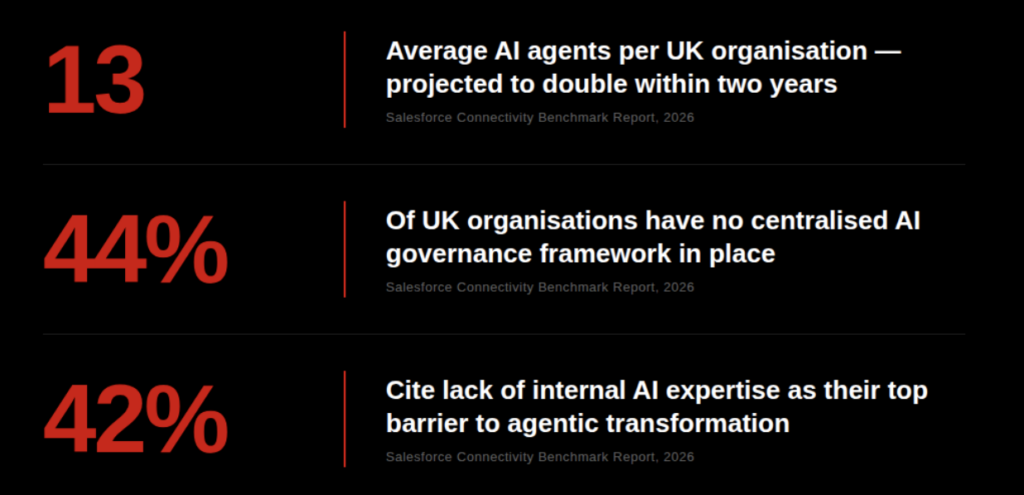
Agentic AI does not wait for instructions. It plans, executes, and adapts across systems without a human approving each step. UK organisations now run an average of 13 AI agents each. That number is projected to double within two years, according to Salesforce’s 2026 Connectivity Benchmark Report.
The technology is scaling. The human infrastructure to govern it is not.
The governance gap is a people gap
The reason agentic AI governance is failing inside UK organisations is not a shortage of frameworks or policy documents, it is a shortage of the human capability to design, embed, and sustain governance in practice.
The report also highlighted that only 56% of UK organisations have a centralised governance framework with formal oversight of their agentic AI capabilities. The 44% without one are not ungoverned by choice. They are ungoverned because their workforce strategy was never designed to include the capability that agentic AI demands.
The same research names the root cause directly. Lack of internal expertise in AI and agent design was cited as a top barrier to agentic transformation by 42% of UK organisations. That is a workforce planning failure. It is the consequence of AI strategy racing ahead while people strategy stands still.
When an AI agent processes personal data without oversight, someone is accountable under UK GDPR. The question is whether your organisation has the right organisational design and the designated person responsible for oversight.
The UK Information Commissioner’s Office published its early thinking on agentic AI in January 2026. The ICO flagged that ad hoc experimentation by employees with agentic systems can complicate Data Protection Officer oversight and lead to unanticipated processing of personal information. The ICO is not describing a software failure. It is describing an organisational one, a failure of human structure and accountability.
What human capability agentic AI governance actually requires
Effective agentic AI governance requires organisations to map the specific human capabilities their AI deployment demands across leadership, operational oversight, and regulatory accountability. Then build workforce strategy around those requirements deliberately.
This is not about creating a new job title and hoping the right person applies. It is about understanding what decisions need human ownership inside an AI-driven operation, what skills and judgement those decisions require, and how the organisation needs to be structured to make accountability function in practice.
The Digital Markets, Competition and Consumers Act 2024 strengthened UK consumer protection law. It applies equally to AI-driven outcomes as to human ones. Regulators are not interested in which system produced the outcome. They are interested in which human was responsible for it, and whether that person had the authority, capability, and organisational backing to do their job.
Most UK organisations have not yet answered those questions. Many have not yet asked them.
Why most organisations cannot hire their way out of this alone
The talent market for people who genuinely understand agentic AI governance is thin, competitive, and poorly understood by most hiring managers which means organisations searching without a clear strategy are wasting time and money on the wrong candidates.
Most job descriptions for AI governance roles are written by people who do not yet know what the role needs to achieve. They borrow language from data protection, from IT security, or from generic AI strategy and end up attracting candidates who can talk the language but cannot do the work.
The organisations closing the agentic AI governance gap fastest are the ones that started by getting clear on what human capability they actually needed. Not a job title or a list of qualifications, but a genuine understanding of the decisions this person will own, the oversight structures they will build, and the regulatory environment they will operate in.
The UK AI governance market is growing at 32.3% annually and is projected to reach $183.8 million by 2033, according to Grand View Research. Demand for people who can navigate this space is accelerating and supply is not keeping up. Without a sharp talent strategy, organisations will keep searching and keep failing to find what they need.
Read our blog on why humans are more important than ever in an AI world.
Retention is the other half of the problem
Even organisations that successfully hire for agentic AI governance roles are losing those people faster than they can replace them — because they have not built the conditions that make senior AI governance professionals stay.
People working at the intersection of AI and governance are in high demand and they know it. The organisations that retain them are the ones that offer clear accountability, executive backing, meaningful scope, and a culture that takes governance seriously rather than treating it as a compliance box to tick.
Agentic AI governance cannot be a bolt-on function with no real authority. The professionals capable of doing this work will not stay in organisations that treat it that way. Building a retention strategy around these roles, including how they are structured, what authority they hold, and how their contribution is valued, is as important as finding them in the first place.
Why AI strategy without workforce strategy creates compounding risk
Every month an organisation deploys agentic AI without a workforce strategy built around it, the capability gap widens, the compliance exposure grows, and the organisational conditions that allow governance to function become harder to build.
The UK AI governance market is growing rapidly and regulatory expectations are moving in the same direction. Organisations that have not built the human infrastructure to meet those expectations will find themselves increasingly exposed, not just to fines, but to the operational fragility that comes from AI systems no one truly owns.
Agentic AI governance cannot be retrofitted around a workforce that was never designed for it. It has to be built in through deliberate decisions about organisational structure, role design, capability development, and leadership accountability.
That work does not happen by accident. It happens when organisations treat their people strategy as the foundation of their AI strategy, not a follow-on consideration.

The organisations getting this right
The UK organisations managing agentic AI governance most effectively share one common quality: they treated workforce capability as the starting point for their AI governance approach, not a consequence of it.
They did not begin by writing a policy. They began by asking which humans in their organisation needed to understand what AI was doing, own accountability for its outcomes, and have the authority to intervene when something went wrong. From those questions, governance structures followed because they were built around real human capability rather than assumed capability that did not exist.
This is the approach that produces governance that actually functions under regulatory scrutiny. It is also the approach that unlocks AI’s commercial promise — because people who genuinely understand what they are overseeing are the ones who know how to get the most from it.
What roles do organisations need for agentic AI governance?
How many UK organisations are currently failing at agentic AI governance?
What is the regulatory risk of poor agentic AI governance in the UK?
What does a talent strategy consultant do to help with agentic AI governance?
How should a UK organisation start closing its agentic AI governance capability gap?

Talk to us
Your AI strategy is only as strong as the people behind it. Let us make sure yours is built to last.