The indirect costs of employment tribunals rarely appear on an invoice, yet they shape outcomes more than most leaders realise. Legal fees are visible and budgeted for. Lost management time, prolonged uncertainty, and reputational exposure are not. Official Ministry of Justice data shows why this matters more now than it did even two years ago.
 The Timeline Itself Is a Cost
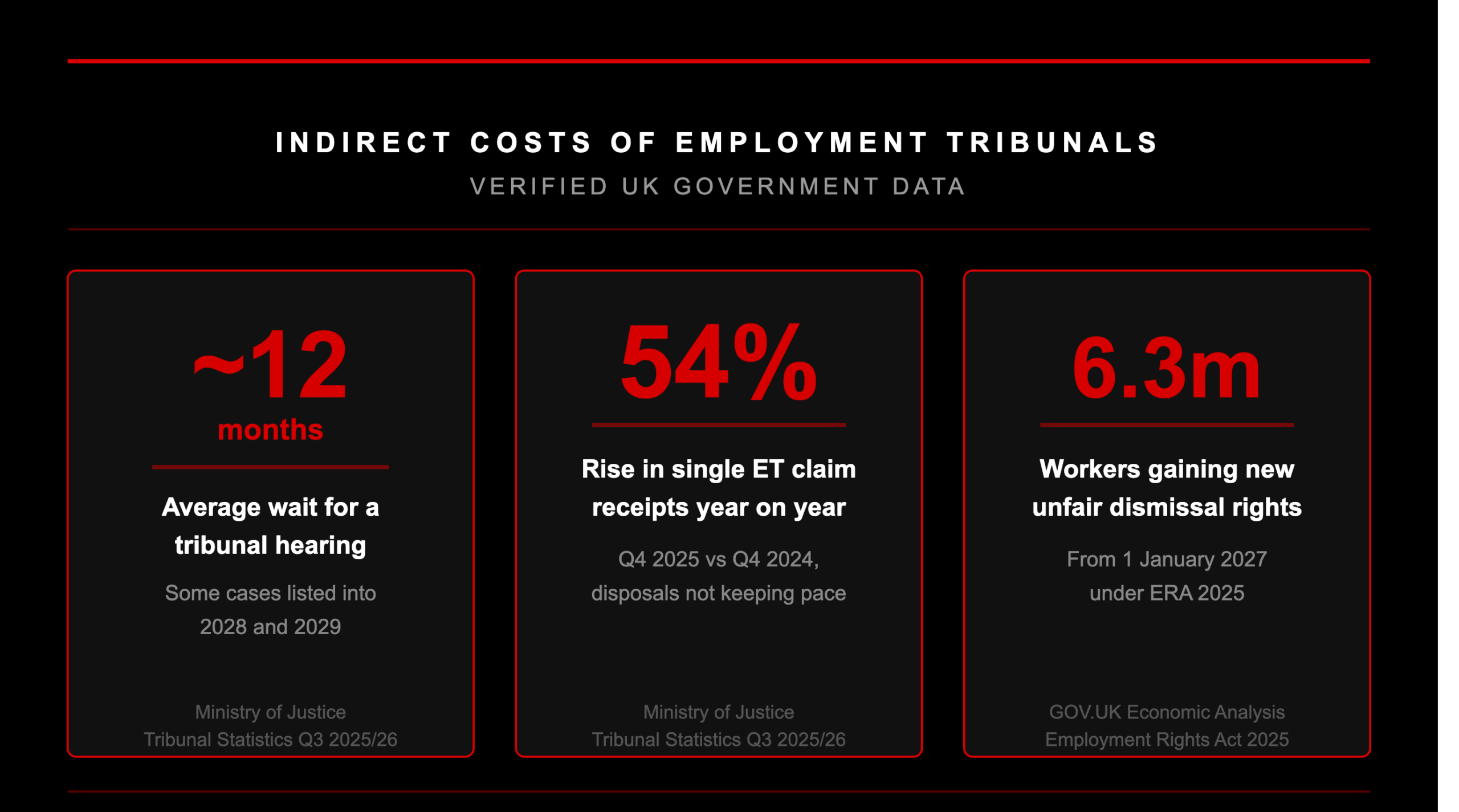
According to Ministry of Justice Tribunal Statistics, single employment tribunal claims now wait an average of approximately 12 months before reaching a hearing. Some cases in London and the Southeast are scheduled into 2028 and 2029. Every month a claim remains open is a month of indirect cost accumulating quietly in the background.
Founders rarely budget for duration. They budget for outcome. A claim that drags on for a year does not just cost more in legal fees. It occupies leadership headspace for a year. Decisions get delayed. Conversations get avoided. Growth plans get shaped around an unresolved risk sitting in the background.
Why Disposal Rates Matter to Your Business
The Ministry of Justice’s Q3 2025/26 data shows single claim disposals running at just 43.5% of new receipts. Claims are entering the system faster than they are leaving it. That structural imbalance has a direct consequence for any employer with an open case. Your claim is not moving through a system designed to resolve it quickly. It is sitting in a queue that is growing longer every quarter.
This matters because indirect costs scale with time, not complexity. A straightforward claim handled badly can sit in the system just as long as a complex one. The backlog does not distinguish. Neither does the cost to your business while you wait.
Read how rising AI adoption triggers workforce changes.
The Cost That Is Easy to Underestimate: Management Time
Defending a tribunal claim requires document collation, evidence gathering, witness statement preparation, and attendance at hearings. None of that work is delegable to a junior team member without senior oversight, particularly for claims involving discrimination or whistleblowing, where credibility and judgement are central to the outcome.
For founder-led and scale-up businesses, this is where the real damage hides. The founder or CEO is often the person closest to the original decision being challenged. They become the person preparing the defence. Every hour spent on that defence is an hour not spent on revenue, hiring, or strategy. The tribunal backlog means that hour stretches across many more months than it would have five years ago.
Workplace Conflict Already Costs UK Employers Billions
Workplace conflict costs UK employers £28.5 billion every year, according to research commissioned by Acas and conducted by the University of Sheffield Management School. That figure includes resignations, dismissals, and sickness absence connected to unresolved workplace disputes, not just claims that reach a tribunal.
Tribunal claims sit at the most expensive end of that wider conflict landscape. A dispute that escalates into a formal claim has already passed through stages where it could have been resolved more cheaply and quickly. By the time a claim is filed, the indirect costs are already compounding.
Read about the governance challenge of agentic AI
The Risk Is Rising, Not Falling
This is not a static picture. Single tribunal claim receipts rose 54% in the final quarter of 2025 compared with the same period a year earlier, according to Ministry of Justice data. The Employment Rights Act 2025 will reduce the unfair dismissal qualifying period from two years to six months from January 2027, bringing an estimated 6.3 million additional employees into scope for protection, according to the Government’s own economic analysis.
The compensatory award cap for unfair dismissal will also be removed entirely from that date. Currently capped at £118,223 or 52 weeks’ gross pay, exposure will become uncapped, mirroring discrimination claims. Every one of these changes increases the volume of claims employers may face and the duration those claims will likely remain open. The indirect cost window is widening at the same time the financial stakes are rising.
What This Means for Decision Makers
Business owners, CEOs, and founders rarely think about tribunal exposure until a claim lands. By then, the indirect costs are already locked in. Time spent defending, reputational uncertainty, and leadership distraction cannot be recovered once the clock starts.
What separates businesses that navigate this well from those that don’t usually comes down to what was built before a claim ever arrived. Clear documentation. Consistent management decisions. A talent strategy that reduces the likelihood of disputes reaching this stage at all. Founders I have worked with who invested in this groundwork before pressure arrived describe a markedly different experience. Fewer disputes. Faster resolution when something does arise. Leadership teams who handle people decisions with confidence rather than fear.
What would a year of recovered management time, reduced uncertainty, and protected reputation be worth to your business right now?
Where This Leaves UK Employers
The indirect costs of employment tribunals are structural, not incidental. They stem from a system under sustained pressure, with disposal rates falling behind receipts and legislative change set to widen exposure further. Waiting for a claim to test your processes is no longer a low-risk strategy. The data confirms the window for acting proactively is narrowing.
Frequently asked questions
What are the indirect costs of employment tribunals?
Indirect costs include lost management time, prolonged uncertainty during a lengthy case, reputational exposure, and the broader disruption to leadership focus. These costs often exceed the direct legal fees involved in defending a claim.
Are UK employment tribunal claims increasing?
How long does it take for an employment tribunal claim to be heard in the UK?
How much does an employment tribunal actually cost a UK employer?
What happens to my business if I lose an employment tribunal claim?
A tribunal that finds against an employer can result in a compensation award, which for unfair dismissal is currently capped at £118,223 or 52 weeks’ gross pay, whichever is lower. There is no cap for discrimination claims. From January 2027, the unfair dismissal cap will be removed entirely under the Employment Rights Act 2025. Beyond compensation, the judgment becomes a matter of public record, since tribunal decisions are published online and hearings are generally open to the press and public.
Will more employees be able to bring unfair dismissal claims in future?
Yes. Under the Employment Rights Act 2025, the qualifying period for unfair dismissal protection will reduce from two years to six months from January 2027. The Government’s own economic analysis estimates this will bring an additional 6.3 million employees into scope for protection.
Is there a cap on compensation for unfair dismissal claims?
Currently, yes. The compensatory award for unfair dismissal is capped at £118,223 or 52 weeks’ gross pay, whichever is lower. From January 2027, the Employment Rights Act 2025 will remove this cap entirely, bringing unfair dismissal exposure in line with discrimination claims, which already carry no cap.
Does losing an employment tribunal claim affect a company’s reputation?
Tribunal judgments are a matter of public record and are publicly accessible online. Hearings are also generally open to the press and public. A finding against an employer, particularly in cases involving discrimination, can become visible to current employees, prospective hires, and customers, independent of any media coverage.
Can a CEO be personally named in an employment tribunal claim?
Senior individuals, including directors and CEOs, can be named personally in certain claims, particularly those involving discrimination, harassment, or whistleblowing, where individual liability provisions under the Equality Act 2010 apply. This is distinct from the company being named as the respondent, which is the more common scenario. Employers should seek tailored legal advice on this point, since liability depends on the specific facts of each case.